CO2 (R744) Cooling
Built for long-duration assets
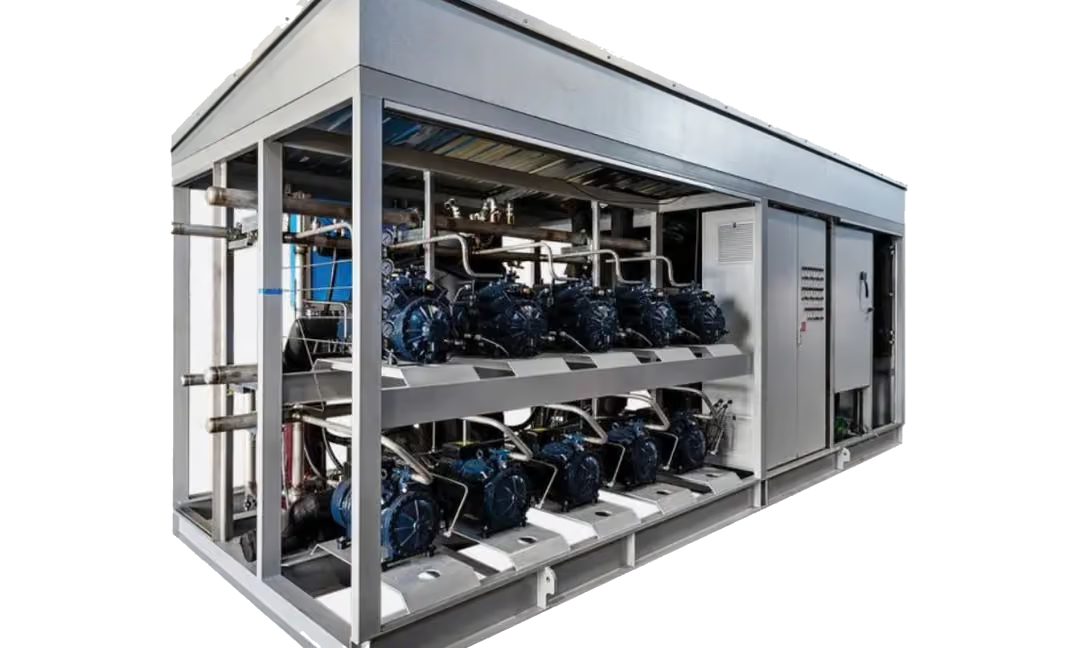
Monashee deploys industrial CO2 refrigeration architecture designed for large-scale data center cooling. The platform addresses growing refrigerant regulation, water use and long-term operating requirements while supporting air, direct-to-chip and immersion cooling environments.
A refrigerant without a phase-out horizon
CO2, also known as R744, is a natural refrigerant. It is PFAS-free and is not subject to the HFC phase-down schedules affecting many conventional refrigerants, reducing long-term exposure to refrigerant substitution and asset obsolescence risk.
Cooling without cooling towers
Dry cooling is the standard configuration, with no evaporative cooling towers. That removes cooling-tower water consumption and reduces exposure to water availability, permitting and community concerns associated with large evaporative cooling loads.
Use cold ambient conditions
In northern climates, pumped CO2 can provide free cooling when ambient conditions allow. This reduces reliance on mechanical compression during cooler periods and makes the architecture particularly well suited to Canada and the northern United States.
Put rejected heat to work
Where a credible nearby heat user exists, the system can provide high-grade recovered heat of up to approximately 90°C for district energy or industrial process applications. Value created from usable heat can be reflected in project economics.
Built for repeatable deployment
Standardized modular architecture allows cooling capacity to be deployed in stages as the data center grows. Long-lead components can be secured in advance, and a practical electrical architecture helps reduce exposure to equipment procurement constraints.
Standardized modules
Repeatable system architecture supports phased deployment across multiple sites.
Commercial-scale feeds
Dual power feeds per module reduce dependence on scarce large industrial switchgear.
Air cooling
The platform can support conventional air-cooled data center environments.
Direct-to-chip
The architecture can support high-density liquid-cooled compute.
Immersion
The cooling platform can integrate with immersion-based heat rejection systems.
Detailed data for qualified projects
Detailed performance information, engineering data and relevant reference installations are available to qualified counterparties under NDA.
Mission-critical cooling infrastructure, developed, financed, owned and operated.
CO2 (R744) Cooling
Built for long-duration assets
Monashee deploys industrial CO2 refrigeration architecture designed for large-scale data center cooling. The platform addresses growing refrigerant regulation, water use and long-term operating requirements while supporting air, direct-to-chip and immersion cooling environments.
A refrigerant without a phase-out horizon
CO2, also known as R744, is a natural refrigerant. It is PFAS-free and is not subject to the HFC phase-down schedules affecting many conventional refrigerants, reducing long-term exposure to refrigerant substitution and asset obsolescence risk.
Cooling without cooling towers
Dry cooling is the standard configuration, with no evaporative cooling towers. That removes cooling-tower water consumption and reduces exposure to water availability, permitting and community concerns associated with large evaporative cooling loads.
Use cold ambient conditions
In northern climates, pumped CO2 can provide free cooling when ambient conditions allow. This reduces reliance on mechanical compression during cooler periods and makes the architecture particularly well suited to Canada and the northern United States.
Put rejected heat to work
Where a credible nearby heat user exists, the system can provide high-grade recovered heat of up to approximately 90°C for district energy or industrial process applications. Value created from usable heat can be reflected in project economics.
Built for repeatable deployment
Standardized modular architecture allows cooling capacity to be deployed in stages as the data center grows. Long-lead components can be secured in advance, and a practical electrical architecture helps reduce exposure to equipment procurement constraints.
Standardized modules
Repeatable system architecture supports phased deployment across multiple sites.
Commercial-scale feeds
Dual power feeds per module reduce dependence on scarce large industrial switchgear.
Air cooling
The platform can support conventional air-cooled data center environments.
Direct-to-chip
The architecture can support high-density liquid-cooled compute.
Immersion
The cooling platform can integrate with immersion-based heat rejection systems.
Detailed data for qualified projects
Detailed performance information, engineering data and relevant reference installations are available to qualified counterparties under NDA.
Mission-critical cooling infrastructure, developed, financed, owned and operated.